


Forty Years on from Chornobyl

Updated: Apr 25
We all know about Chornobyl. Don’t we? …Do we? How much do you really know about it, four decades later?
The fortieth year since the nuclear plant accident in what is now Ukraine arrives in a remarkably new — and improved — landscape of public perception.
Without a doubt, the dramatic telling of the events during, and after, April 26th, 1986 in the seminal HBO miniseries spurred sincere curiosity in minds relatively fresh to the subject, who found much of the older, often selective coverage from large environmental organisations pretty deficient. Overall, the show accurately emphasised how the shortcomings of the Soviet political system underpinned design problems and bad operational practice, and led to the steam explosion, fuel fire and severe damage at the plant, as well as the deception and desperate face-saving in the aftermath.
Despite the geopolitical turmoil and national secrecy of the time, radiation experts like Jack Valentin in Sweden, in May 1986, declared prophetically,
“The death toll from Chernobyl, tragic though it is, has fallen far short of that from a major airplane crash. The important thing is to retain a sense of proportion. All nations must work a lot harder to reduce radiation hazards, but we mustn't succumb to panic. There are other serious problems, after all.”
In contrast, an interview with a pessimistic Russian specialist in 1991 asserted,
“The official figure of 31 mortalities represents those who died in the original explosion. The actual toll of those who perished as a result of the "cleanup" is 5,000 to 7,000, and many thousands more throughout southern Russia will die of radiation poisoning or related cancers… Dr. [Vladimir] Chernousenko, fatally afflicted with radiation poisoning, believes that at least 35 million people have been damaged.”
During the years that followed, while international scientific agencies methodically gathered and analysed data on human and environmental impacts, anti-nuclear organisations persistently traded on the damage – real and imagined – for their agenda.
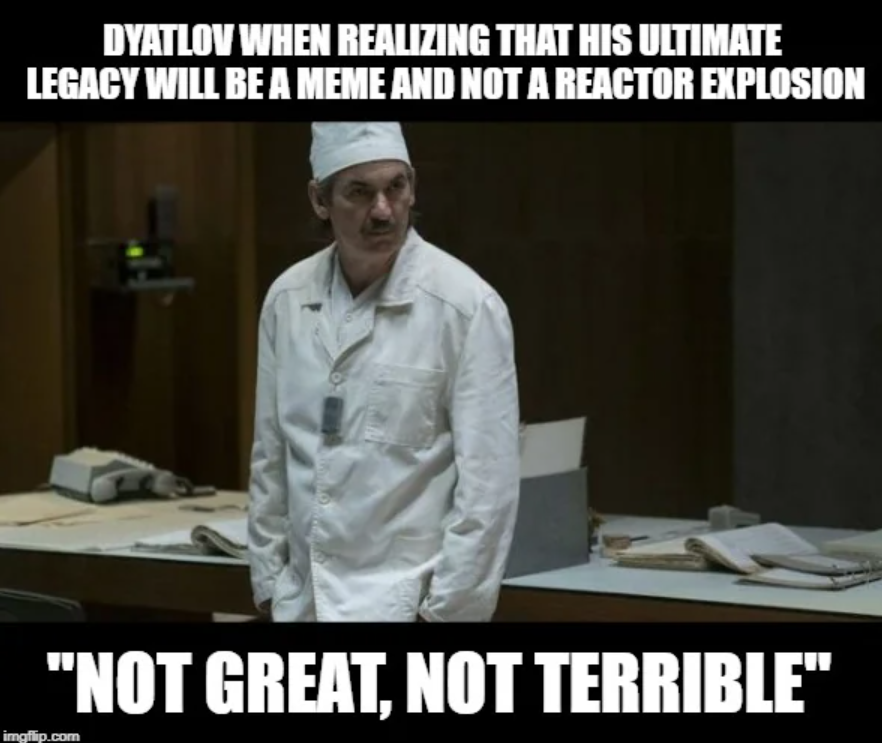
Now, at the forty year mark, practically all that exploitable uncertainty has given way to scientific understanding, time-tested engineering confidence, and strikingly good news for both the environment and people impacted by Chornobyl. And instead of lingering horror and aversion to any mention of nuclear, its legacy in the social consciousness is a meme about 3.6 Roentgens per hour.
Chornobyl "contaminated" the rest of Europe… or did it?
Maps of the modelled plume spread over Europe are routinely posted on social media, normally devoid of details about the type of contamination, the scales of exposure, the realistic hazard to covered populations or even how it’s supposed to affect anyone (that’s left up to the imagination).
Those plume maps look a lot like this, but for one Eastern European nuclear plant rather than countless coal power stations spread over much of the continent. See a visualisation of coal pollution over Europe here.
A 2024 conference paper reported a preliminary estimate of 318 million human life-years lost through ambient fossil fuel pollution health impacts resulting from cessation of nuclear plant construction in democratic countries after Chornobyl.
It’s a matter of record that dust and smoke from Chornobyl drifted over many European countries. Two of the most heavily affected were Finland and Sweden, with contamination falling to the ground over a few days, and much of it decaying to nothing in roughly the same timespan.
What was the effect on human health? The Radiation and Nuclear Safety Authority of Finland notes,
“According to a [2013] study conducted by STUK, the Cancer Registry and the National Institute for Health and Welfare, the fallout caused by the Chernobyl nuclear accident has not noticeably increased the number of cancers in Finland.”
Uppsala University researchers reported last year that,
“According to cancer statistics in Sweden, in total 1.9 million cancer cases were registered from 1986 to 2023. […] an additional number of 850,000 cancer cases can be estimated up to 2036 making a total of 2.8 million for the full time period 1986 to 2036. Therefore, our additional […] estimated attributable cases due to Chernobyl fallout [825 cases] amounts to 0.029% of the gross background cancer cases in Sweden.”
These results for Finland and Sweden bear out multidisciplinary work from twenty years ago which concluded “the results of analyses of trends in cancer incidence and mortality do not appear to indicate (except for thyroid cancer) a measurable increase in cancer incidence in Europe to date, related to radiation from the Chernobyl accident.”
Surely the Exclusion Zone is dangerous?
It’s illegal to move into the zone.

Take care not to confuse illegal with dangerous with uninhabitable.
As Professor Geraldine Thomas, retired founder of the Chernobyl Tissue Bank, has explained, the exclusion zone remains in place for the safety and security of the reactor site.
“...it's not recommended that they live there, but there are people who've lived there ever since the accident.”
They can expect an average dose over twenty-five years equivalent to one CT scan.
The relative absence of people has allowed a combination of active and passive rewilding, as detailed in 2023 by Professor Germán Orizaola from the University of Oviedo. The entire presentation is worth a watch.
Landscapes are well into the process of regenerating forest and wetlands, while populations of lynx, brown bear, bison, moose, black stork, and rare endangered species such as the white-tailed eagle and capercaillie are firmly established.
“Animals live in Chornobyl, they breed in Chornobyl, they fulfil their life-cycles inside Chornobyl, with no effects.”
- Germán Orizaola
Considering the invaluable, unforeseen ecological recovery within the zone, even if the remaining radioactivity was removed or the region made “habitable” for humans some other way, it should be protected as it is.
The accident itself was deadly though, right?
Of the plant's 600 staff, twenty-eight died within three months due to radiation exposure, and the remaining survivors’ health is monitored. More widely, follow-up of over 67 thousand Chornobyl emergency workers was undertaken, and analysis in 2015 concluded that “no increase in the mortality from all cancers among the emergency workers as compared to the baseline mortality in Russian men was found.”
So, no cancer clusters even among plant workers or liquidators? What about DNA damage? It has been well-characterised in the decades since, but thankfully found to not be inherited by offspring.
In sad contrast to all of this, surrounding populations suffered more thyroid cancer due to ingestion of Iodine-131 (generally in contaminated milk) in the months before it completely decayed away. Many thousands of extra cases began being diagnosed in 1990, with children being particularly impacted. But in 2013, research revealed how the vast majority of treated patients have survived, most in complete remission.
Let's consider an alternative scenario.
If Chornobyl had not been a nuclear power station, no meltdown would have been able to occur. That's certainly the outcome many anti-nuclear groups would have preferred and still use to justify campaigning against existing and new nuclear power stations.
The most likely alternative to a nuclear power station would have been coal. Coal was at the time, and still remains, the dominant source of electricity generation.
A new report by WePlanet and the Anthropocene Institute explores this counter-factual.
Had Chornobyl been a coal-burning power plant of equivalent size, generating the same electricity from 1977 to 2023, the human toll would likely have been far worse. The analysis estimates between 33,728 and 106,002 deaths from routine coal operation, mostly from fine-particle air pollution, along with hundreds of thousands of serious illnesses and tens of millions of minor illnesses. In other words, the worst nuclear accident in history appears to have caused far less harm than decades of normal coal combustion would have caused at the same site.
A “Coal Chornobyl” would also have emitted vast quantities of CO₂, while releasing lead, mercury and cadmium on a scale comparable to the annual heavy-metal pollution of entire countries. And although the actual accident released more radioactive material by mass in a single catastrophic burst, the coal counterfactual would have emitted radionuclides continuously over decades, including isotopes with far longer half-lives. There would have been no meltdown. But there would have been a slower, quieter, and probably much larger public-health disaster.
What is the anti-nuclear campaign even on about?
Public perception of pervasive, persistent health impacts, and of lingering danger; conflation of old soviet designs with robustly sealed western construction; and erosion of confidence in specialised scientific-engineering coalescence exemplified by operation of nuclear power reactors has been ruthlessly exploited by anti-nuclear groups and politicians in the decades since the accident in Ukraine. We do not seek to dismiss the harm from the event, but that harm has clearly turned out to be dramatically overestimated. Far more people and animals are now alive than expected by their darkest predictions of disease and environmental ruin, and we invite them to join us in being grateful for it.
Editors note: Chornobyl is the official Ukrainian transliteration of the city and disaster site, reflecting the correct Ukrainian spelling (Чорнобил), while Chernobyl is the Russian-derived spelling used internationally during the Soviet era. We choose to use the Ukrainian transliteration in solidary with the Ukrainian people defending their homeland from Russia.

For more on the Chornobyl accident you can read our interview with Serhii Kurykin, a former anti-nuclear leader and now the founder of WePlanet Ukraine. Article here.